
Information’s Awakening: From Medieval Logos to Wheeler’s Quantum Bits
In 1989, John Archibald Wheeler (1911-2008) – one of the most influential American theoretical physicists and the man Stephen Hawking called “the hero of the black hole story” – delivered a paper at a Tokyo physics symposium that would fundamentally challenge our understanding of reality. Already renowned for his work with Niels Bohr on nuclear fission and for coining terms like “black hole” and “quantum foam,” Wheeler now proposed something even more radical: that the physical universe emerges from information.
The paper, “Information, Physics, Quantum: The Search for Links,” reads like an intellectual detective story. Wheeler suggested that at the smallest scales, space and time themselves dissolve into a granular foam of binary choices. Everything we consider real – particles, fields, forces, even the smooth fabric of spacetime – emerges from this deeper informational bedrock. A photon isn’t really a “thing” until we measure it; the measurement itself, the act of asking nature a yes-no question, brings it into existence (https://philpapers.org/archive/WHEIPQ.pdf).
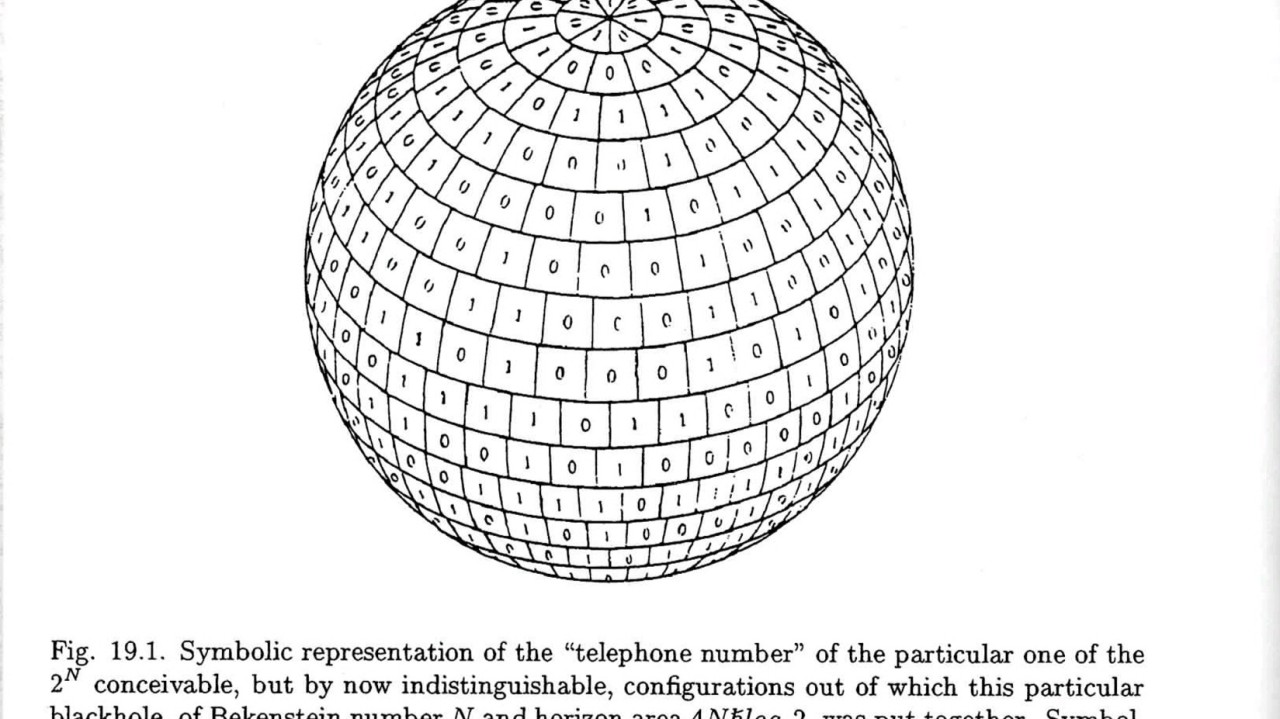
Just as a novel’s reality springs from the arrangement of letters on a page, our physical world, Wheeler argued, arises from the interplay of binary yes-no questions and answers – what he memorably termed “it from bit.”
The implications are dizzying. If Wheeler is right, then the universe isn’t like a giant machine ticking away according to predetermined laws. Instead, it’s more like a vast computational process, a cosmic game of twenty questions where reality emerges through the accumulation of billions upon billions of binary choices. Observer and observed, questioner and questioned, become inextricably linked in this participatory universe.
The paper is structured around three questions (“How come existence?”), four prohibitions (“No space, no time”), and five tantalizing clues. Like a detective story where the mystery is existence itself, Wheeler leads us through the evidence with both scientific rigor and philosophical daring. His vision unifies quantum mechanics, information theory, and fundamental physics into a cohesive picture that still challenges and inspires physicists today.
The Pattern Before Matter: Wheeler’s Quantum Echo of Aquinas
However, this insight wasn’t entirely new. Seven centuries earlier, medieval thinkers had conceived of the universe as fundamentally informational. Thomas Aquinas developed a sophisticated framework understanding reality as emerging from divine patterns or “rationes” – what we might today call information structures. In his vision, the divine Word (Logos) wasn’t merely a theological concept but represented the fundamental architecture of reality itself (https://isidore.co/aquinas/english/John1.htm).
Both frameworks – Wheeler’s physics and Aquinas’s metaphysics – converge on a universe where pattern precedes matter, where information is fundamental, and where physical reality emerges from an immaterial foundation. Wheeler expressed this through his famous phrase “it from bit,” suggesting that everything physical (“it”) derives from responses to yes-or-no questions (“bits”). In Aquinas’s framework, physical things emerge from and participate in eternal patterns that exist in the divine intellect.
This historical resonance adds depth to Wheeler’s insights. The intuition that information underlies physical reality isn’t new – it’s been part of sophisticated philosophical frameworks for centuries. Wheeler’s genius lay in translating this ancient insight into the language of modern physics and providing experimental frameworks to test it, drawing on his deep understanding of quantum mechanics and general relativity.
Reality’s Hidden Code: From Divine Forms to Quantum Information
Wheeler’s radical proposition that “every it – every particle, every field of force, even the spacetime continuum itself” derives from binary yes-no choices finds a surprising parallel in Aquinas’s understanding of how the Word contains the archetypal forms of all created things. For Aquinas, the Word is not simply divine speech but the perfect expression of divine wisdom, containing within itself the patterns or “rationes” from which physical reality emerges. Just as Wheeler saw bits as the fundamental building blocks of physical reality, Aquinas saw these divine patterns as the source from which all material existence springs forth.
This convergence becomes particularly striking when we consider Wheeler’s emphasis on observer participation. For Wheeler, reality emerges through the acts of observer-participants who pose questions to nature and register responses. This remarkably mirrors Aquinas’s insight that creation is not a static given but a dynamic participation in divine wisdom. Both thinkers see reality as fundamentally participatory rather than mechanistic.
The practical implications of this convergence are profound for modern technology. When we build quantum computers, we are essentially working with Wheeler’s bits at their most fundamental level. But Aquinas’s framework helps us understand why this works – because reality itself has an inherently information-theoretic structure. The medieval insight that patterns precede and give rise to physical reality helps explain why mathematical symmetries so often predict physical discoveries.
Aquinas’s understanding of how patterns give rise to physical existence helps explain why information-theoretic approaches to physics have been so successful.
Perhaps most profoundly, this synthesis suggests new approaches to consciousness and free will. If reality emerges from observer-participation, as Wheeler proposed, and if this participation reflects a deeper pattern-based structure of reality, as Aquinas analyzed, then consciousness may be fundamental rather than emergent. Free will might be understood as our participation in the information-theoretic structure of reality rather than as an anomaly to be explained away.

Robert Nogacki is a Polish attorney at law (radca prawny), the founder and managing partner of Kancelaria Prawna Skarbiec (Skarbiec Law Firm), which has operated continuously since 2006.
The law is equal for everyone, but the parties rarely are: on one side stands an organization with time, money, and lawyers, on the other a person with one business, one nest egg, and one life.
Clients rarely come to him with a legal problem. They come with a problem that also has a legal side: an audit that began with a single invoice, money entrusted to someone who has disappeared, a company that has to be passed on before it is too late. Most such matters are decided long before the first letter is written, in decisions made without asking and in deadlines nobody remembered. So he begins by asking how the client got here, not what the client should have done.
He advises entrepreneurs and families from more than a dozen countries, including those whose accounts the tax office has just seized and who do not know what to do tomorrow morning. He defends them in tax audits, customs and fiscal inspections, disputes with the tax authorities, and criminal tax proceedings. He represents victims of investment fraud and Ponzi schemes. He helps families set up family foundations and plan succession, so that a life’s work outlasts a single generation.
Not every case can be won. Every case can be run so that the client knows where they stand. Since 2006 he has represented the victims in the WGI case (Warszawska Grupa Inwestycyjna, the Warsaw Investment Group), one of the longest criminal cases in the history of the Polish financial market, because some things must not be left half finished, even when they take two decades. In the case of the collapsed cryptocurrency exchange Zonda (Zondacrypto, operated by BB Trade Estonia OÜ), he represents several hundred victims in the criminal investigation conducted by Poland’s National Prosecutor’s Office and in the Estonian bankruptcy proceedings.
Kancelaria Prawna Skarbiec is listed in the rankings of Poland’s largest tax advisory firms published by Dziennik Gazeta Prawna and Rzeczpospolita, and it is a four-time recipient (2015 to 2018) of the European Medal awarded by the Business Centre Club and the European Economic and Social Committee. Robert Nogacki publishes regularly, in the press and on the firm’s website, for people who have a problem rather than a law degree, because a legal opinion the client cannot understand protects only the lawyer.
He believes that the best legal advice is the kind that means the client never has to appear in court.